

“Tuition reimbursement NYC” refers to a legal remedy under IDEA that repays parents for private-school tuition when the public school fails to provide FAPE. This blog will walk you through when reimbursement applies, how it compares to public-school services, notice and filing rules, and what evidence persuades hearing officers. What FAPE Requires—and Why That Matters for Reimbursement Under the Individuals with Disabilities Education Act (IDEA), New York public schools must provide a Free Appropriate Public Education (FAPE) through an Individualized Education Program (IEP) tailored to the student. FAPE doesn’t promise the “best” program—it requires services reasonably calculated to enable progress. In practice, the IEP must include appropriate goals, placement, and related services (Speech/OT/PT/counseling), delivered in the Least Restrictive Environment (LRE). When districts meet FAPE, families typically rely on public-school services. When they don’t, parents can pursue private placement and seek tuition reimbursement or prospective (direct) funding through due process. Is Public School Still Working? Early Warning Signs Before you consider private school, watch for signals the current IEP isn’t working: Persistent lack of progress despite services and reasonable fidelity to the IEP Unsafe or inappropriate environment (bullying, significant behavior issues without adequate supports) IEP implementation failures (missed therapies, shortened sessions, absent paraprofessional, ignored accommodations) Administrative delays (late evaluations, missed annual review, no placement identified before school starts) If multiple signs are present, escalate internally (teacher → case manager → CSE chair/special-education director). Keep written documentation—service logs, emails, progress reports, incident reports. Strong documentation is the backbone of any tuition case. Two Paths When Public Services Fail: Improve the IEP or Seek Private Placement When the public program isn’t delivering FAPE, parents generally have two strategic paths: 1) Fix the Public Program Request a CSE meeting to revise goals/services, add behavior supports (BIP), increase service frequency, or change placement. Ask for compensatory education to make up missed services. Consider mediation to secure prompt changes without a hearing. This path can be faster and less adversarial if the district is responsive. 2) Pursue Private Placement (With Legal Funding Options) When the district cannot or will not offer an appropriate program, families may unilaterally place their child in a private school designed for their needs and seek: Carter reimbursement (you pay first; seek reimbursement later), or Connors (prospective) funding (the district pays tuition directly, if you prove you cannot front the cost). Both routes require showing the district failed FAPE, the private program is appropriate, and equities (good-faith cooperation and timely notice) favor the parents. Key Terms: Carter vs. Connors, “Nickerson” Letters, and the CBST Carter reimbursement: After enrolling in a non-approved private school, parents seek retroactive repayment of tuition through a hearing. Connors/prospective funding: If parents cannot prepay tuition, they request an order directing the DOE to pay the school directly (you must also show financial inability to prepay). Nickerson (P-1) letter: If the DOE fails to identify a state-approved placement within timelines (typically 60–65 days), a Nickerson letter can authorize enrollment in an approved school at public expense. CBST (Central-Based Support Team): NYC unit that connects students to state-approved nonpublic schools when the CSE determines the district program is not appropriate. The Three-Prong Test at a Due-Process Hearing Whether you seek Carter or Connors, hearing officers typically apply a three-prong analysis: Did the district deny FAPE? Inadequate IEP (goals/services/placement not aligned to needs) Implementation failure (services not delivered as written) Procedural violations that impeded educational benefit or parental participation Is the private placement appropriate? Small classes, specialized instruction, related services, progress-monitoring, and strategies targeted to the child’s profile Evidence from independent evaluations, progress data, teacher testimony Do equities favor the parents? 10-business-day notice given before removal from public school Parents cooperated: attended meetings, visited proposed placements, kept an open mind Reasonable, documented rationale for choosing the private program If all three prongs favor the parents, the IHO may order reimbursement (Carter) or direct payment (Connors). Courts can also award compensatory education in tandem where missed public services caused regression. The 10-Day Notice Rule—And Why Timing Matters Before moving your child to private school, IDEA requires parents to notify the district in writing at least 10 business days in advance. The notice should: State that you believe the IEP is inadequate and the district failed to offer FAPE Identify the private school you intend to enroll your child in Request tuition reimbursement or prospective funding Invite the district to reconvene the CSE to address deficiencies Best practice: Send notice before signing a contract or paying a deposit. Courts differ on when a child is considered “removed,” so give notice early to preserve the equity prong. Use certified mail or email with read receipts and keep copies. Evidence Parents Should Gather (What Persuades IHOs) IEPs (current and prior), progress reports, and service logs showing missed sessions or lack of progress Independent evaluations (neuropsych, speech-language, OT/PT, behavior) with precise recommendations Private school documentation (class size, methodology, related services, data on the child’s progress) Parent logs (dates, times, service gaps, incidents) and correspondence with staff Observation notes and placement visit summaries (public and private) Tip: Organize a chronological “hearing binder” with tabs for IEPs/evaluations/progress data/communications. Precision and completeness demonstrate credibility and support equities. Public Services vs. Private Placement: A Side-by-Side View Consideration Public-School Services Private Placement (Carter/Connors) Cost to Family No tuition; services at school High tuition; reimbursed later (Carter) or paid directly (Connors) if you win Speed to Implement Can be slow (evaluations, CSE timelines) Immediate if you enroll and can secure interim tuition/aid Control Over Program District controls; must offer FAPE/LRE Program tailored by private school; appropriateness must be proven Risk If FAPE is met, no reimbursement case If you lose, you carry tuition risk (Carter); Connors mitigates risk if granted Documentation Burden Moderate (monitor IEP and logs) High (prove FAPE denial, private appropriateness, equities) Remedies Comp ed, new IEP/placement, services Reimbursement or direct pay; possible comp ed as well “When Should We Use Legal Action?” Use legal action when you have credible evidence that the district failed FAPE, the IEP revisions

Pendency or ‘Stay-Put’ Rights under IDEA in NYC: Protect Your Child During Disputes
A pendency order (the “stay-put” rule) keeps your child in the last agreed-upon placement—with the same services—while a special education dispute is pending in NYC. This blog will walk you through what pendency is, when it starts, how to invoke it, funding and duration rules, limits under recent case law, and practical steps to protect your child. What Is Pendency (Stay-Put) and Why It Exists Pendency—often called “stay-put”—is a legal protection under IDEA that automatically preserves a student’s “then-current educational placement” for the entire dispute, including mediation, impartial hearings, and appeals. Its purpose is to maintain stability and prevent a district from unilaterally changing services during litigation—functioning like an automatic injunction. In NYC practice, pendency starts when a parent files a due-process complaint or a mediation request and continues until the parties settle or a final decision becomes final. What Counts as the “Then-Current Educational Placement”? Courts and state guidance generally define then-current placement as (a) the placement in the most recently implemented IEP, (b) the actual program the student was attending when the complaint was filed, or (c) a prior order (IHO/SRO/court) setting the program. Pendency can encompass services (e.g., speech therapy) and not just a classroom label, and a private-school program can be the pendency placement if it was part of the last agreed program or set by a prior order. Importantly, stay-put guarantees the type and level of services—not necessarily the exact school building or teacher. Districts retain authority to determine the location for delivery, as long as they replicate the agreed program during pendency. How to Invoke Pendency in NYC (Step-by-Step) File a Due-Process Complaint (DPC) or Mediation Request Pendency is triggered by filing. If the district does not voluntarily implement stay-put, you can ask the Impartial Hearing Officer (IHO) for a pendency order at (or even before) the hearing. Request a Pendency Order from the IHO In a pendency hearing, both sides argue what constitutes the last agreed program; the IHO issues a written order identifying the services/placement protected. NYC’s hearing materials explain this process for families. Paper Trail & Precision Matter Keep copies of IEPs, prior IHO/SRO orders, placement letters, provider logs, and send key communications by certified mail/email with read receipts. Precision evidence speeds pendency determinations. (Parent training guides emphasize meticulous record-keeping for pendency and enforcement.) Who Pays—and How Long Does Pendency Last? Funding: The school district must continue paying for the pendency program, including private-school tuition or private services if those are part of the last agreed program. These payments do not have to be repaid even if parents ultimately lose the case on the merits. Duration: Pendency continues through all appeals and ends only at settlement or final decision (i.e., when the order is final and no longer appealable). Warning on unilateral changes: If parents unilaterally move to a different private school without DOE authorization or a pendency determination, pendency funding is at risk. Limits and Recent Case Law You Should Know Not an IEP meeting decision: Pendency is a legal injunction, not a service a CSE can grant. It’s ordered by an IHO (and enforceable/appealable). Ventura de Paulino (2d Cir. 2020): Parents cannot unilaterally switch a child from a pendency-funded private school to a new private school during the dispute and automatically demand pendency funding for the new school. Districts may decide where the agreed program is delivered, and only “substantially similar” substitutions approved by an IHO may qualify. Recent NY SRO decisions: State Review Officers repeatedly affirm that IDEA and NY law require stay-put at the then-current placement unless the parties agree otherwise, and that pendency disputes focus on the existing program—not whether it’s appropriate. Recent decisions also clarify that rate disputes are generally outside a pendency order. Transitions (EI → CPSE; CPSE → Kindergarten): Special rules may apply during age-level transitions; DOE must maintain agreed services, though the school setting may change to reflect age/grade. Parent guides detail these nuances. Pendency for Private-School Students and IESP Cases For students enrolled in nonpublic schools, the pendency program may arise from an IESP (Individualized Education Services Program) or a prior IHO/SRO order. In such cases, the district must fund the last agreed-upon services until the case is resolved; pendency is an automatic injunction and does not depend on parents proving the merits at that stage. The inquiry is what the current program is, not whether it’s ideal. Practical Guidance for NYC Parents (Do This Early) 1) Build a “Pendency Packet.” Include the most recent implemented IEP, any IHO/SRO orders, progress reports, provider logs, and letters confirming the program/services your child actually receives. (This packet becomes the backbone of your stay-put claim.) 2) File Quickly—and in Writing. Pendency attaches when you file (DPC or mediation). If your child’s services are being reduced or moved, act immediately so stay-put can lock the program in place during the dispute. 3) Ask the IHO for a Pendency Order if Needed. If the district delays, explicitly request a pendency order from the IHO. NYC provides process details and separate implementation guidance (including new SupportHub workflows for orders issued after Jan 8, 2025). 4) Understand the Tradeoffs. Pendency protects existing services but can delay the start of new services you’re requesting until the case is resolved—so weigh strategy with your attorney. (Parent training and advocacy materials highlight this “stability vs. progress” tradeoff.) 5) Consult an Attorney Early. An experienced education lawyer NYC / NYC DOE due process lawyer helps define the then-current placement, prepares evidence for the pendency hearing, and navigates Ventura-era limits (e.g., “substantially similar” arguments). NYC hearing guides explain how IHOs and the DOE’s Implementation Unit carry out orders. How a Lawyer Strengthens a Pendency Case Defines the pendency program precisely (services, frequency, delivery model) using IEPs, provider logs, and prior orders. Frames the record to show continuity (e.g., same program since prior IHO order) and rebut district attempts to narrow services. Argues Ventura-compliant positions, including “substantially similar” when necessary. Moves for immediate relief (pendency order) and follows through on implementation with

IEP Implementation Failure in NYC: What to Do & How a Lawyer Helps
An IEP implementation failure in NYC occurs when the Department of Education does not deliver the services, accommodations, or placement promised in your child’s Individualized Education Program (IEP). Parents have legal rights to enforce compliance under IDEA. This blog will walk you through what constitutes an IEP failure, why it matters, the steps parents should take, and how an experienced attorney can protect your child’s right to a Free Appropriate Public Education (FAPE). Overview of IEPs and Why Implementation Matters An Individualized Education Program (IEP) is a legally binding document between a public school district and a family. It sets out: The child’s academic and functional goals Accommodations and modifications (e.g., preferential seating, assistive technology) Special education services (resource room, self-contained classes) Related services such as speech therapy, occupational therapy (OT), physical therapy (PT), or counseling Progress monitoring and reporting requirements When implemented correctly, the IEP ensures that children with disabilities receive the services necessary to access learning. For the district, compliance also protects against legal liability under the Individuals with Disabilities Education Act (IDEA). But when schools fail to implement an IEP as written, they risk denying FAPE, which can trigger disputes, complaints, and corrective legal action. What Constitutes IEP Implementation Failure? Implementation failures are more than small mistakes. They’re systemic breakdowns that deny a child legally mandated services. Common examples include: Missed therapies or services (speech, OT, PT) Incomplete or shortened sessions compared to what’s listed in the IEP Failure to deliver accommodations (such as preferential seating, assistive technology, or extra testing time) Wrong placement (placing the student in a setting inconsistent with the IEP, violating the Least Restrictive Environment requirement) Staff shortages leading to unqualified or unavailable service providers Improper IEP team composition or excluding parents from participation Missed timelines for evaluations, reviews, or annual meetings In NYC, with the size of the DOE, these failures often occur due to overextended staff or administrative delays. Still, parents are entitled to strict compliance. Consequences of Implementation Failure When an IEP is not followed, the consequences go far beyond a missed session: Loss of instructional time leads to academic regression Delayed progress in speech, motor, or social skills Emotional harm such as frustration, low self-esteem, or behavioral issues Teacher burnout and increased stress on school staff Legal and ethical liability for schools that repeatedly fail to comply The usual legal remedy is compensatory education—extra services designed to make up for lost instruction. This may occur after school, during weekends, or via private providers paid for by the DOE. Steps for Parents When the IEP Isn’t Being Followed If you suspect an iep implementation failure nyc, here are steps to take: 1. Document & Communicate Keep a written log of missed services or accommodations. Save emails or notes from teachers and providers. Contact the service provider directly for clarification. 2. Escalate Within the School or District Speak with your child’s special education teacher or principal. Involve the district’s special education director if the issue persists. 3. Request Compensatory Services Parents can request makeup sessions or compensatory education from the DOE. This requires showing how much service was missed and how it impacted progress. 4. Facilitated IEP Meetings & Mediation New York provides facilitated IEP meetings and state-appointed mediators to help resolve disputes without litigation. Mediation is voluntary but often successful. 5. File Formal Complaints If informal steps fail: State complaint: Filed with the New York State Education Department when the DOE violates IDEA or ignores a hearing officer’s decision. Due process complaint: Initiates a legal proceeding before an Impartial Hearing Officer (IHO), who can order remedies such as compensatory education or tuition reimbursement. How a Special Education Attorney Helps An experienced iep meeting lawyer nyc plays a critical role: Case review: Analyze whether the school is complying with state and federal laws. Identify violations: Distinguish between procedural vs. substantive failures. Advocacy at meetings: Attend CSE meetings to ensure parents’ voices are heard. Negotiation: Work toward informal agreements, like revising the IEP or adding services. Representation: Handle mediation, impartial hearings, OCR complaints, or litigation if necessary. Attorneys also fight for compensatory education and can secure tuition reimbursement if private placement is appropriate. NYC-Specific Procedures and Resources Parents in New York City should know about local procedures: Impartial hearing process: Independent hearing officers review disputes. Enforcement: If the DOE fails to follow an IHO order, parents can file a state complaint. Local resources: New York State Education Department complaint procedures Advocacy organizations like AFC (Advocates for Children of New York) Specialized firms such as Susan Luger Associates or Gerschel Law Preventing IEP Implementation Failures While some failures are unavoidable, schools and parents can minimize risks: Set measurable goals and baseline data in the IEP Regular progress monitoring and reporting to parents Staff training to ensure team members know legal obligations Proper IEP team composition including required specialists and parent involvement Parental engagement—parents should actively review logs, progress notes, and push for accountability Conclusion and Resources IEP implementation failures in NYC deny students their right to a meaningful education under IDEA. Parents should document issues, escalate concerns, and—when necessary—use legal remedies to secure services. With the support of CSE meeting attorney nyc or a compensatory education lawyer nyc, families can hold the DOE accountable and ensure their children get the education they deserve. FAQs About Iep Implementation Failure Nyc Q1: What qualifies as an IEP implementation failure in NYC? A: It includes missed or shortened services, failure to provide accommodations, improper placement, or delays in starting mandated supports. Q2: How do I document missed services or accommodations? A: Keep a written log, collect progress reports, and save emails from teachers or providers confirming service gaps. Q3: What is compensatory education and how is it calculated? A: Compensatory education makes up for missed services, usually by adding hours outside regular school time. It’s based on the amount of service lost. Q4: What are the timelines for filing a state or due process complaint in NY? A: Generally, complaints must be filed within two

IEP Issues for Children with Autism in NYC
What Parents Need to Know When a child with autism receives an Individualized Education Program (IEP) in New York City, parents often face unique challenges in ensuring their child’s needs are properly addressed. Autism presents a wide range of learning and developmental differences, and when an IEP fails to capture these, students may be left without the support they need to thrive. At our NYC law firm, we advocate for families navigating IEPs and ensure that children with autism receive the services, supports, and accommodations they are entitled to under the law. Common IEP Issues for Children with Autism Autism impacts multiple areas of development, which means that IEPs for autistic students must be specific, individualized, and measurable. Unfortunately, many IEPs fall short in the following areas: Communication Needs Children with autism often experience challenges in expressive and receptive communication. An IEP may fail to: Include appropriate speech therapy services Provide augmentative and alternative communication (AAC) options if verbal language is limited Address pragmatic language skills (social use of language) Social Interaction Skills Autism frequently affects how children build and maintain relationships. Schools may overlook: Social skills training or group support Structured opportunities for peer interaction Goals that help with collaboration, conversation, and play Behavioral Supports Behavior is communication. If an IEP only labels behavior as “disruptive” without a Functional Behavioral Assessment (FBA) and Behavior Intervention Plan (BIP), the child’s needs are not being met. Sensory Processing Needs Sensory sensitivities can make classrooms overwhelming. Missing supports may include: Sensory breaks Quiet spaces Occupational therapy to help with regulation Key Challenges Parents Encounter Even when these areas are addressed, many parents run into common problems with their child’s IEP: Lack of Clarity: Goals may be vague or written in a way that makes it impossible to measure progress. Masking: Children with autism sometimes “mask” their struggles in school, appearing to cope, while their real challenges are overlooked. Vague Goals: Goals such as “improve communication” or “increase social skills” are not specific or actionable, making accountability difficult. How Parents Can Help Parents play a vital role in advocating for their child. Here are some steps you can take: Document Everything: Keep records of communications, evaluations, and progress reports. Request Assessments: Ask for comprehensive evaluations in communication, behavior, and sensory processing. Push for Specific Goals: Ensure goals are measurable, time-bound, and tailored to your child’s needs. Observe and Share: Provide real-world examples of your child’s challenges at home and in the community. How an IEP Attorney Can Help in NYC Even with advocacy, schools may resist or delay providing appropriate services. An experienced special education attorney can: Review your child’s IEP for legal compliance and sufficiency Demand necessary evaluations and services Represent you at IEP meetings or impartial hearings Challenge vague or inappropriate goals Hold the NYC Department of Education accountable under federal and state special education laws Summary Every child with autism deserves an education tailored to their needs. When an IEP falls short, students risk missing out on critical supports during the most important years of their development. Parents do not have to face these challenges alone. Working with an attorney who understands autism-related IEP issues in NYC can make a life-changing difference. If you believe your child’s IEP is not meeting their needs, contact our NYC IEP attorneys today for a consultation. Together, we can ensure your child receives the education and support they deserve.
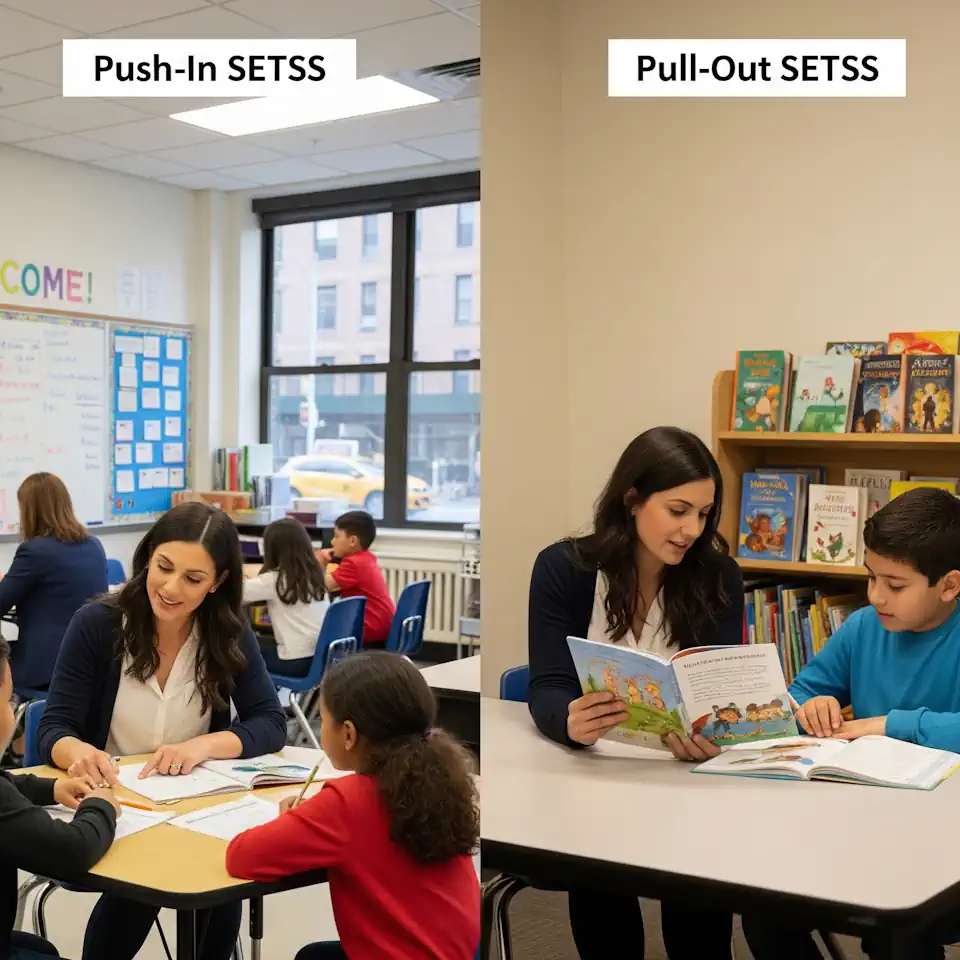
Push-In & Pull-Out SETSS in NYC
What Are Push-In Services? Push-in Special Education Teacher Support Services (SETSS) occur when a licensed special education teacher provides instruction within the general education classroom. Instead of being pulled out, the student remains with peers while receiving individualized support. When Do Push-In Services Work Best? Push-in services are especially effective when: A student can follow the general curriculum with targeted assistance. Collaboration between the classroom teacher and SETSS provider enhances instruction. Social inclusion and peer modeling are important for the child’s development. Who Receives Push-In Support? Students with Individualized Education Programs (IEPs) who need extra help but can succeed in a general education classroom often receive push-in services. Common areas of focus include reading comprehension, organization, and classroom participation. Benefits of Push-In Services Inclusion: The child learns alongside peers in a natural classroom setting. Collaboration: Teachers coordinate strategies for consistency. Confidence: Students avoid stigma by staying in class. Practical Application: Skills are reinforced immediately during lessons. Limitations of Push-In Services Less individualized attention compared to small pull-out groups. Classroom distractions may interfere with instruction. Teachers must manage roles carefully to avoid overlap or confusion. How Push-In Supports Overall Learning Push-in services allow students to access the general curriculum while still receiving specialized support. They promote inclusion, confidence, and independence, helping students thrive without isolating them from peers. What Are Pull-Out Services? Pull-out Special Education Teacher Support Services (SETSS) take place when a student leaves the general education classroom to work in a smaller group or one-on-one with a special education teacher. This environment provides targeted instruction away from classroom distractions. When Do Pull-Out Services Work Best? Pull-out services are most effective when: A student requires focused attention to learn specific skills. The general classroom environment is too overwhelming. Intensive instruction is needed to catch up in reading, writing, or math. Who Receives Pull-Out Support? Students with IEPs who need direct, specialized instruction that cannot be fully provided in the classroom benefit most from pull-out services. Benefits of Pull-Out Services Personalized Instruction: Tailored to the child’s unique learning style. Reduced Distractions: Small settings allow for better focus. Skill-Building: Ideal for teaching foundational skills. Confidence Growth: Students can practice without pressure from peers. Limitations of Pull-Out Services Students may miss portions of classroom instruction. Can create a sense of separation from peers. Requires careful coordination to prevent gaps in learning. How Pull-Out Supports Overall Learning Pull-out services provide the intensive, individualized support some students need to make progress. When combined with push-in support, they ensure that children receive the right balance of inclusion and targeted intervention. Together, push-in and pull-out services complement each other. One keeps the student engaged in the classroom while the other provides focused support. The right mix depends on your child’s needs, as outlined in their IEP.

Special Education Teacher Support Services (SETSS) in NYC
What Families Need to Know Navigating the New York City special education system can be overwhelming for parents and guardians who want to ensure their child receives the right educational support. One key service available is Special Education Teacher Support Services (SETSS). Understanding how SETSS works, who qualifies, and how to access these services is essential for advocating effectively for your child. What Are Special Education Teacher Support Services (SETSS)? SETSS is a type of special education support provided by certified special education teachers to students with disabilities who require extra help to succeed academically. Unlike full-time special education classes, SETSS is designed to supplement instruction in the least restrictive environment possible—usually in a general education classroom or in small pull-out groups. The goal of SETSS is to help students access the general curriculum by providing individualized or small-group instruction tailored to their learning needs. Who Qualifies for SETSS? SETSS applies to students in New York City public schools (and in some cases, non-public schools) who have been found eligible for special education services through the Individualized Education Program (IEP) process. A student may qualify if evaluations show they need additional instructional support in areas such as: Reading comprehension Writing skills Mathematics Organization and study skills Attention and behavior management The exact amount and frequency of SETSS a student receives will be written into their IEP after the Committee on Special Education (CSE) review. How to Get SETSS for Your Child The process of securing SETSS typically involves: Referral for Evaluation – Parents, teachers, or school staff may refer a child for an IEP evaluation if academic or behavioral concerns persist. Comprehensive Evaluation – The school district conducts assessments in areas like academics, cognition, and behavior. CSE Meeting – The Committee on Special Education reviews the evaluations and determines eligibility. IEP Development – If eligible, SETSS may be recommended and included in the IEP, specifying how many sessions per week and in what setting (push-in, pull-out, or both). Implementation – The school arranges for a licensed special education teacher to provide the services. If the DOE cannot provide a teacher directly, families may sometimes be issued Related Services Authorizations (RSAs) to seek SETSS providers privately. Types of SETSS Services in NYC SETSS can be delivered in different formats depending on the child’s needs: Push-In Services – The SETSS teacher works with the student inside the general education classroom. Pull-Out Services – The student works with a SETSS teacher in a small group outside the classroom. Hybrid Services – A combination of push-in and pull-out support. Instruction can cover academic content, skill development, or strategies for learning and organization. Benefits of Receiving SETSS When implemented correctly, SETSS can provide significant benefits: Tailored instruction that meets a student’s unique learning needs. Support in accessing the general curriculum alongside peers. Improved academic skills, confidence, and independence. Collaboration between SETSS teachers and general education teachers. Early intervention that can prevent a widening academic gap. Cost of SETSS to Families For families, SETSS is free of charge when provided through the Department of Education as part of a student’s IEP. If the DOE is unable to provide services, parents may have the right to secure private providers at no cost, but this sometimes requires legal advocacy to enforce. When an Attorney Can Help Summary While many families secure SETSS without issue, legal representation may be needed in situations such as: Delays in the evaluation or IEP process Insufficient or inappropriate SETSS recommendations Failure of the DOE to provide SETSS as written in the IEP Disputes over placement, frequency, or service delivery Challenges obtaining private providers through RSAs An experienced special education attorney in NYC can advocate on your child’s behalf, ensure compliance with the law, and file for due process if necessary. Ready to take action? Contact Gerschel Law for a free consultation and protect your child’s future. SETSS can be a vital support for students who need extra help to thrive in the classroom. But too often, families encounter delays, gaps in services, or inadequate recommendations. Knowing your rights and when to involve an attorney can make all the difference in securing the education your child deserves. If you believe your child qualifies for SETSS but has not been properly evaluated—or if the DOE is failing to deliver the services written in your child’s IEP—consulting with a special education lawyer in NYC can protect your child’s right to a free and appropriate public education (FAPE).

What Is FAPE and How Can I Enforce It in NYC Schools?
Free Appropriate Public Education (FAPE) is the cornerstone of your child’s rights under the IDEA. In New York City, enforcing FAPE often requires navigating IEP disputes, pendency orders, or even due process hearings with the NYC DOE. If you’re searching for an education lawyer nyc, this guide explains everything you need to know. This blog will walk you through what FAPE really means, how it applies in NYC schools, and the legal steps you can take if your child is being denied services. Understanding FAPE Under IDEA FAPE stands for Free Appropriate Public Education, a legal right guaranteed under the Individuals with Disabilities Education Act (IDEA). It ensures that students with disabilities receive special education and related services designed to meet their unique needs—at no cost to families. Key principles of FAPE: Why this matters in NYC: The NYC Department of Education (DOE) is the largest school district in the U.S. With over 200,000 students receiving special education, disputes around IEPs and FAPE are common—and enforcement can be complicated. Signs Your Child May Be Denied FAPE in NYC Parents often sense something is wrong before they have legal confirmation. Common red flags include: If any of these sound familiar, consulting with a special education lawyer nyc may be your next step. How to Enforce FAPE Rights in NYC Enforcing FAPE can feel overwhelming, but there is a clear roadmap. 1. Request a CSE/CPSE Meeting The first step is to formally request a meeting with the Committee on Special Education (CSE) or Committee on Preschool Special Education (CPSE). This allows you to challenge services, goals, or placement. Tip: Put your request in writing and keep copies. Written records are essential for due process. 2. File for Mediation Parents can ask for mediation with the DOE to resolve disputes informally. While non-binding, mediation sometimes results in quicker agreements without going to hearing. 3. Due Process Complaint & Impartial Hearing If issues remain unresolved, parents can file a due process complaint. An Impartial Hearing Officer (IHO) reviews the case and makes a legally binding decision. At this stage, many parents hire an nyc doe due process lawyer to prepare evidence, witnesses, and case law (such as Burlington and Carter tuition reimbursement precedents). 4. Pendency (Stay-Put) Protection While disputes are ongoing, your child has the right to remain in their last agreed-upon placement under the pendency (“stay-put”) rule. This prevents schools from moving students into inappropriate settings during litigation. 5. Tuition Reimbursement If the public school fails to provide FAPE, parents may place their child in a private school and seek tuition reimbursement. The DOE is legally required to reimburse costs if the private placement is deemed appropriate under IDEA standards. Why Work with an Education Lawyer in NYC? The NYC DOE has extensive legal resources. Parents navigating this system alone often feel outmatched. Hiring an education law attorney new york provides: Most firms, including Gerschel Law, offer an education lawyer,—allowing you to understand your options before committing. Conclusion FAPE is not just a legal acronym—it’s your child’s right to meaningful education. In NYC, enforcing that right may require persistence, documentation, and sometimes legal action. If you believe your child is being denied services, consulting with an education lawyer nyc ensures you have an advocate who understands both the law and the NYC DOE system. Ready to take action? Contact Gerschel Law for a free consultation and protect your child’s future. FAQs About Education Lawyer Nyc / Iep Nyc Q1: What does FAPE mean in special education? A: FAPE means Free Appropriate Public Education, a right under IDEA ensuring students with disabilities receive tailored services at no cost. Q2: How can I enforce my child’s IEP in NYC? A: Document failures, request a CSE meeting, and if unresolved, file a due process complaint with the help of a special education lawyer NYC. Q3: What is pendency or “stay-put” in NYC schools? A: Pendency ensures your child stays in their last agreed placement during disputes, preventing the DOE from making changes until resolved. Q4: Can I get tuition reimbursement if my child is denied FAPE? A: Yes. If the DOE fails to provide FAPE, you may enroll your child in private school and seek reimbursement under IDEA case law. Q5: Do I need a lawyer for a DOE due process hearing in NYC? A: While not required, an NYC DOE due process lawyer improves your chances by presenting evidence, preparing witnesses, and citing case law.